
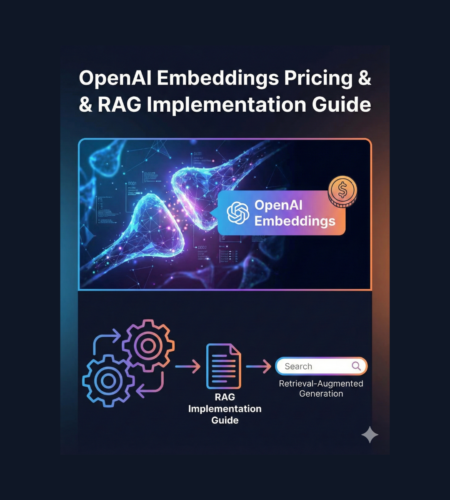
In today’s AI-driven world, OpenAI Embeddings and Retrieval Augmented Generation (RAG) are reshaping the landscape of machine learning and natural language processing (NLP). Whether you’re a developer, AI engineer, or business owner looking to leverage AI for your products, understanding OpenAI Embeddings pricing and the nuances of RAG implementation is crucial for success. In this blog, we will dive deep into these technologies and provide a detailed guide on how you can implement RAG using OpenAI embeddings while also exploring the pricing structure involved.
What Are OpenAI Embeddings?
OpenAI Embeddings are a type of machine learning model designed to represent words, phrases, or entire documents in a vector space. These embeddings capture the semantic meaning of text by encoding it into a high-dimensional vector format, which can then be used for various NLP tasks, such as:
- Semantic Search
- Text Similarity
- Sentiment Analysis
- Recommendation Systems
OpenAI embeddings are at the heart of Retrieval Augmented Generation (RAG), where they help provide context and accurate information to improve the performance of generative models like GPT-3 or GPT-4.
OpenAI Embeddings Pricing: What You Need to Know
The cost of using OpenAI Embeddings is a key consideration for businesses and developers, especially when scaling AI-powered solutions. OpenAI offers a pricing model based on usage, which typically includes charges for the number of tokens processed in requests to the Embeddings API.
OpenAI Embeddings Pricing Structure
As of 2025, OpenAI pricing for embeddings is as follows:
- Base pricing: OpenAI charges per 1,000 tokens used in API requests.
- Token pricing varies depending on the type of model used (e.g., base models vs. advanced models).
- Scaling costs: As you increase the number of API calls or process larger datasets, the cost per token may decrease, making large-scale implementations more affordable over time.
Why Pricing Is Crucial for Your AI Projects
When implementing RAG or similar NLP-based systems, it’s essential to understand the cost implications. If your project involves processing a significant amount of text or making frequent API calls, OpenAI Embeddings’ pricing can quickly add up. Therefore, it’s critical to:
- Estimate token usage: Calculate how many tokens your dataset or input text will consume.
- Consider model selection: Some models might offer better cost efficiency for your specific use case.
- Optimize usage: Minimize token usage where possible by filtering irrelevant content and reducing redundant requests.
By keeping these factors in mind, you can better budget your AI projects and prevent unexpected costs.
What Is Retrieval Augmented Generation (RAG)?
Retrieval Augmented Generation (RAG) is a hybrid AI architecture that combines retrieval-based techniques with generative models to enhance the quality and accuracy of responses. In traditional generative models, the model relies solely on its internal knowledge, which is limited by its training data and knowledge cutoff. However, with RAG, the model has access to external, real-time data, significantly improving its response quality.
RAG Pipeline
- Indexing: The first step is to index your data. You break your content (like articles, videos, documents) into smaller chunks, convert them into embeddings, and store these embeddings in a vector database.
- Querying: When a user asks a question or provides a query, the system retrieves the most relevant chunks from the vector database.
- Generation: These retrieved chunks are then fed into a generative model like GPT-4, which uses the context to craft a more accurate and informative answer.
This process helps mitigate issues like hallucinations (where models generate inaccurate or fabricated information) by grounding the response in relevant external data.
Implementing RAG with OpenAI Embeddings
Now that we understand the basics of OpenAI embeddings and RAG, let’s explore how to implement a RAG-based solution using OpenAI embeddings.
Step 1: Set Up Your OpenAI API
To begin with, you’ll need to access the OpenAI API. If you haven’t already, create an account on the OpenAI platform and generate an API key. With this key, you can interact with OpenAI models, including the Embeddings API.
Step 2: Index Your Data
To implement RAG, the first step is to index your data using OpenAI embeddings. Start by converting your text data (e.g., documents, articles, or product information) into vector embeddings. These vectors will be stored in a vector database (such as Pinecone, FAISS, or Weaviate).
Here’s a basic example of how you might index data using OpenAI embeddings:
import openai

openai.api_key = "your-api-key"

# Embedding a sentence using OpenAI's Embeddings API
response = openai.Embedding.create(
    model="text-embedding-ada-002",
    input="Example sentence for embedding"
)

embedding = response['data'][0]['embedding']
Store these embeddings in a vector database for efficient retrieval.
Step 3: Query the Database
Once your data is indexed, the next step in RAG is querying. When a user inputs a query, the system will retrieve the most relevant chunks of data from the vector database based on the embeddings.
Example:
# Query example
query = "What are the benefits of RAG?"

# Convert the query to an embedding
query_embedding = openai.Embedding.create(
    model="text-embedding-ada-002",
    input=query
)['data'][0]['embedding']

# Retrieve relevant chunks from the vector database
# (This step depends on the specific database you use, such as FAISS or Pinecone)
Step 4: Generate Contextual Responses
Once relevant data chunks are retrieved, they are passed to a generative model like GPT-3 or GPT-4. This model uses the retrieved context to generate an accurate response, grounded in the real-time data.
Benefits of RAG with OpenAI Embeddings
- Improved Accuracy: By retrieving real-time data, RAG systems can provide more accurate and relevant responses.
- Reduced Hallucinations: Since the model draws information from external sources, it’s less likely to generate false or hallucinated information.
- Scalability: As your data grows, you can continuously update the vector database with new content without retraining your generative model.
- Customizability: RAG systems can be tailored to specific use cases by adjusting the indexing and querying steps.
Conclusion: Optimizing OpenAI Embeddings Pricing & RAG Implementation
When working with OpenAI Embeddings, understanding the pricing model is crucial for efficient budgeting and cost management. By calculating token usage and optimizing your API calls, you can scale your AI solutions without breaking the bank. On the other hand, RAG implementation offers a powerful way to enhance AI systems by combining retrieval-based approaches with generative models. With OpenAI Embeddings, you can build scalable and accurate AI solutions that provide real-time, contextually grounded answers, minimizing errors and improving performance.
By following the steps outlined in this guide, you’ll be well on your way to implementing cutting-edge RAG systems using OpenAI Embeddings—whether for semantic search, question answering, or advanced AI applications. Keep experimenting with different architectures, optimize your token usage, and make the most out of OpenAI’s powerful tools.
Comments