
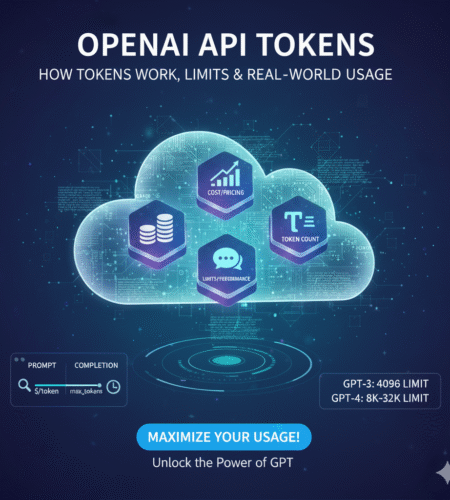
When using OpenAI’s API to interact with models like GPT-3 or GPT-4, understanding OpenAI API tokens is essential for optimizing your usage. Tokens are the smallest units of text that the models process, and they have a significant impact on pricing, performance, and cost management. In this guide, we’ll dive deep into how tokens work, the limits of tokens in GPT-3 and GPT-4, and provide a real-world case study of token usage in a chatbot application for an e-commerce platform.
What Are OpenAI API Tokens and How Do They Work?
At the core of OpenAI’s API are tokens. These are small chunks of text that the models use to process and generate language. Tokens can be words, parts of words, or punctuation marks. For example:
- The word “hello” is 1 token.
- The sentence “Hello, how are you?” is split into multiple tokens: “Hello”, “,”, “how”, “are”, “you”, “?”
Understanding OpenAI API tokens is crucial because they directly affect costs and how the API processes requests. The number of tokens in both your prompt (the text you input) and completion (the response from the model) determines the overall token usage for a request.
How OpenAI API Pricing Works Based on Token Usage
Every request you make to OpenAI’s API has a cost based on the number of tokens used. This includes both the prompt tokens (your input) and the completion tokens (the model’s output). For example:
- Prompt: “Tell me a story about a dragon.”
- Tokens: 7 (for example, the words “Tell”, “me”, “a”, “story”, “about”, “a”, “dragon”)
- Completion: “Once upon a time, there was a dragon who lived in a faraway land.”
- Tokens: 17 (the words and punctuation marks in the response)
In this example, the total token usage for this request is 7 (prompt tokens) + 17 (completion tokens) = 24 tokens.
The pricing for OpenAI’s API is typically around $0.0020 per 1,000 tokens (this may vary based on the model you’re using). So, in the above example, the cost for this request would be very small.
Why Token Usage Affects Pricing
- The more tokens you use, the higher the cost. If you send large prompts or ask the model to generate long responses, the cost will increase.
- Managing your token usage is crucial to staying within budget, especially for projects with high-volume requests.
Understanding GPT-3 Token Limits and How They Affect Your Requests
Every model has token limits. For instance:
- GPT-3: Can process up to 4,096 tokens in a single request. This includes both the prompt and the completion tokens combined.
- GPT-4: Supports much larger token limits, ranging from 8,192 tokens to 32,768 tokens, depending on the version you are using.
If your input (prompt) and output (completion) together exceed the model’s token limit, the request will fail. To avoid this, ensure that the total tokens do not exceed the maximum limit.
How Token Limits Impact OpenAI API Pricing
If you exceed the token limit, you might need to shorten the prompt or adjust the response length, reducing the total number of tokens used. Understanding GPT-3 token limits and GPT-4 token limits helps in optimizing both the performance and cost-efficiency of your usage.
For example, if you have a request that uses 3,500 tokens (for both prompt and completion), you would still have some room left to add additional tokens before hitting the GPT-3 limit.
Managing Token Usage in OpenAI API
Efficient token usage is crucial for maintaining low costs and ensuring that your requests do not hit the token limits. Here are some tips for managing token usage effectively:
- Be concise in your prompts: Keep your inputs short and to the point. The shorter your input, the fewer tokens it will consume.
- Limit the completion length: You can set a maximum token limit for the model’s response. If you don’t need a long answer, you can restrict the number of tokens generated in the completion.
- Batch process: If you have multiple questions, try to batch them into a single request to save tokens and reduce the number of API calls.
Real-World Case Study: Implementing a Chatbot Using OpenAI API Tokens
Let’s look at a real-world case study of how OpenAI token usage can affect costs and performance. A company running an e-commerce platform decided to integrate a chatbot powered by GPT-3 to help customers with product recommendations, answering queries, and assisting with order tracking.
Initial Setup
The e-commerce chatbot is built using GPT-3. Here’s an example interaction:
User Question: “Can you help me find a laptop under $1000?”
Prompt Tokens:
- “Can” (1 token)
- “you” (1 token)
- “help” (1 token)
- “me” (1 token)
- “find” (1 token)
- “a” (1 token)
- “laptop” (1 token)
- “under” (1 token)
- “$1000” (1 token)
Total Tokens in Prompt = 9 tokens
Chatbot Response: “Sure! We have several laptops under $1000, such as the Dell XPS 13, HP Pavilion, and Apple MacBook Air. Would you like more details on any of them?”
Completion Tokens:
- “Sure!” (1 token)
- “We” (1 token)
- “have” (1 token)
- “several” (1 token)
- “laptops” (1 token)
- “under” (1 token)
- “$1000” (1 token)
- “such” (1 token)
- “as” (1 token)
- “the” (1 token)
- “Dell” (1 token)
- “XPS” (1 token)
- “13” (1 token)
- “HP” (1 token)
- “Pavilion” (1 token)
- “and” (1 token)
- “Apple” (1 token)
- “MacBook” (1 token)
- “Air” (1 token)
- “Would” (1 token)
- “you” (1 token)
- “like” (1 token)
- “more” (1 token)
- “details” (1 token)
- “on” (1 token)
- “any” (1 token)
- “of” (1 token)
- “them?” (1 token)
Total Tokens in Completion = 27 tokens
Total Token Usage = 9 tokens (prompt) + 27 tokens (completion) = 36 tokens
Cost Estimation
If the chatbot handles 10,000 requests per month, and each request uses approximately 36 tokens, the total token usage for the month would be:
- 10,000 requests × 36 tokens per request = 360,000 tokens per month
With OpenAI’s pricing of approximately $0.0020 per 1,000 tokens, the cost would be:
- 360,000 tokens ÷ 1,000 = 360 units
- 360 × $0.0020 = $0.72
Thus, the monthly cost for 10,000 chatbot interactions would be $0.72.
Optimizing Token Usage for Cost-Efficiency
To reduce costs, the e-commerce company could:
- Shorten responses to avoid generating long completions.
- Limit the number of tokens in the prompt by keeping user queries concise.
- Set a limit on completion tokens, ensuring that the chatbot only provides essential responses.
Conclusion
Understanding OpenAI API tokens is crucial for managing costs and performance when working with OpenAI’s models like GPT-3 and GPT-4. By being mindful of the token limits and token usage in both prompts and completions, you can optimize your API requests for cost-efficiency.
For applications like chatbots, ensuring that your token usage remains within budget while providing high-quality responses is key. By following best practices for managing token usage, you can maximize the value you get from OpenAI’s API without exceeding your cost targets.
Now that you understand GPT-3 token limits, OpenAI pricing based on tokens, and how to manage token usage effectively, you can make more informed decisions about how to use OpenAI’s API in your own projects.
Comments