If you are planning a SaaS product in 2026, one of the first questions you will probably ask is:
How much does it cost to build a SaaS platform?
For most custom SaaS projects, there is no useful single-number answer.
A focused MVP may require a relatively modest development budget, while a production SaaS with multi-tenancy, subscription billing, advanced permissions, third-party integrations, reporting, AI features, mobile apps, or compliance requirements can cost several times more.
Quick answer
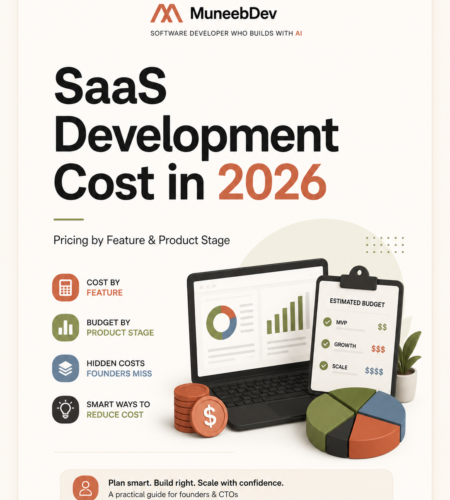
For early planning, SaaS development costs can broadly fall into these ranges:
| Product stage | Planning budget |
|---|---|
| Prototype / proof of concept | $5,000–$15,000 |
| Focused SaaS MVP | $15,000–$50,000 |
| Growth-ready SaaS platform | $50,000–$150,000 |
| Complex / enterprise SaaS | $150,000–$500,000+ |
These are planning ranges, not fixed quotes or universal market averages.
The actual SaaS development cost depends on your workflows, architecture, integrations, security requirements, product maturity, team model, and how much functionality needs to exist at launch.
Two founders can both say:
“I want to build a SaaS platform.”
One may need a $20,000 product.
The other may be describing a $200,000 system.
The difference is usually hidden in the details.
How Much Does It Cost to Build a SaaS Platform in 2026?
A better way to estimate the cost of building a SaaS product is to first determine what stage you are actually building.
1. Prototype or proof of concept: $5,000–$15,000
A prototype is designed to validate an idea, workflow, or technical assumption.
It might contain:
- basic authentication
- one primary workflow
- simple user interface
- limited administration
- little or no automation
- basic deployment
The objective is not to create the final SaaS business.
It is to answer an important question:
Is this idea worth investing in further?
2. Focused SaaS MVP: $15,000–$50,000
A SaaS MVP should be capable of serving real early users while intentionally excluding functionality that can wait.
A typical MVP might include:
- user registration and login
- organization accounts
- basic multi-tenancy
- core business workflow
- subscription billing
- admin dashboard
- transactional emails
- basic reporting
- production deployment
- backups and monitoring
This is where many founders should start.
The goal is not to build everything competitors have.
It is to build enough for customers to successfully complete the core job your product exists to solve.
3. Growth-ready SaaS: $50,000–$150,000
Once real customers begin using the platform, requirements usually expand.
You may need:
- multiple user roles
- granular permissions
- multiple subscription plans
- advanced reporting
- APIs
- webhooks
- several third-party integrations
- workflow automation
- audit logs
- improved onboarding
- higher availability
- AI-powered functionality
- better observability
At this stage, architecture matters increasingly because shortcuts made during the MVP can begin slowing development.
4. Enterprise SaaS: $150,000–$500,000+
Enterprise requirements can change the project significantly.
Typical additions include:
- SSO/SAML
- complex role hierarchies
- enterprise account structures
- advanced audit logging
- data residency requirements
- sophisticated billing
- multiple environments
- compliance requirements
- large integration ecosystems
- advanced analytics
- multi-region infrastructure
- strict security controls
- dedicated mobile applications
The software may look similar to an ordinary SaaS product from the outside.
Underneath, the engineering requirements can be very different.
SaaS Development Cost by Feature in 2026
This is where SaaS estimates become more useful.
Rather than asking only:
“How much does SaaS development cost?”
break the platform into modules.
The table below provides illustrative planning allowances, not fixed prices. Feature complexity can vary dramatically between products.
| SaaS feature/module | Typical planning range | Complexity |
|---|---|---|
| Authentication & accounts | $1,500–$6,000 | Low–Medium |
| Admin dashboard | $3,000–$10,000 | Medium |
| Multi-tenancy | $4,000–$15,000+ | Medium–High |
| Roles & permissions (RBAC) | $3,000–$10,000+ | Medium–High |
| Subscription billing | $3,000–$12,000 | Medium |
| Core custom workflow | $5,000–$25,000+ | Varies |
| Third-party integration | $2,000–$10,000+ each | Medium–High |
| Reporting & analytics | $4,000–$15,000+ | Medium–High |
| AI / RAG functionality | $5,000–$30,000+ | Medium–High |
| Mobile application | $15,000–$50,000+ | High |
| Enterprise security/compliance | Highly variable | High |
Why are the ranges so wide?
Because “subscription billing”, for example, can mean two completely different things.
Product A:
- one monthly plan
- one annual plan
- simple Stripe checkout
Product B:
- multiple pricing tiers
- free trials
- coupons
- seat-based pricing
- usage billing
- upgrades
- downgrades
- prorations
- failed-payment recovery
- taxes
- invoices
- enterprise contracts
Both requirements appear on a feature list as:
“Stripe subscription integration.”
They are not the same engineering task.
What Actually Determines SaaS Development Cost?
The technology stack matters, but it is rarely the biggest factor.
The largest cost drivers are usually:
- Core workflow complexity
- Multi-tenant architecture
- Roles and permissions
- Subscription and billing rules
- Third-party integrations
- Reporting and analytics
- AI functionality
- Security and compliance
- Mobile requirements
- Product design and QA
Let’s look at the important ones.
1. Core Workflow Complexity
Feature count is a poor way to estimate software.
Consider a booking SaaS.
A basic version might allow a customer to:
- choose a service
- choose an available time
- book an appointment
- receive confirmation
Now add real business requirements:
- multiple organizations
- multiple branches
- employee availability
- different service durations
- recurring appointments
- cancellation windows
- rescheduling
- deposits
- coupons
- travel time
- customer history
- employee calendars
- time zones
- Google Calendar
- Microsoft Calendar
- SMS reminders
- different staff permissions
It is still called a booking platform.
But it has become a completely different development project.
This is why estimates should be based on workflows and business rules, not only page counts.
2. Multi-Tenant Architecture
Most B2B SaaS platforms eventually need some form of multi-tenancy.
Multi-tenancy means multiple organizations use the same SaaS application while their users, permissions, configuration and data remain separated.
For example:
- Company A has 20 employees.
- Company B has 50 employees.
- Both companies use the same SaaS.
- Company A must never access Company B’s information.
Implementing that correctly affects:
- authentication
- database queries
- permissions
- files
- notifications
- reporting
- APIs
- background jobs
- billing
- audit logs
- application configuration
I encountered these decisions directly while building a multi-tenant booking SaaS for a client.
One important lesson from that work is:
Multi-tenancy is much easier to design intentionally than to retrofit later.
If you know your product will serve organizations rather than individual users, discuss the tenancy model before development starts.
3. User Roles and Permissions
Login functionality itself is usually straightforward.
Permissions are where complexity grows.
A simple application might have:
- user
- administrator
A B2B platform may need:
- platform administrator
- organization owner
- administrator
- manager
- employee
- accountant
- customer
- read-only user
Then come questions such as:
- Can managers see revenue reports?
- Can employees edit customers?
- Can administrators change billing?
- Can one employee access another employee’s schedule?
- Can users belong to multiple organizations?
- Can permissions vary between locations?
This is role-based access control, or RBAC.
The number of screens may barely change.
The amount of backend logic does.
4. Subscription Billing
Many SaaS specifications contain one innocent-looking requirement:
“Integrate Stripe.”
The actual payment API may be straightforward.
The billing rules around it often aren’t.
You may need:
- monthly plans
- annual plans
- free trials
- upgrades
- downgrades
- prorations
- coupons
- usage limits
- per-seat billing
- metered billing
- invoices
- taxes
- cancellation logic
- grace periods
- failed-payment recovery
- billing webhooks
A SaaS charging every customer one flat monthly amount is significantly easier to build than a platform charging according to seats, locations, API calls, storage or AI usage.
Define the pricing model early.
It affects architecture.
5. Third-Party Integrations
Modern SaaS products rarely operate independently.
Common integrations include:
- Stripe
- PayPal
- Google Calendar
- Microsoft 365
- Twilio
- SendGrid
- HubSpot
- Salesforce
- QuickBooks
- Slack
- mapping services
- industry-specific APIs
The cost is not determined by the words “API integration.”
A production integration may require:
- OAuth
- refresh tokens
- permissions
- data mapping
- webhooks
- retries
- rate-limit handling
- synchronization
- duplicate prevention
- error logging
- reconciliation
A one-way integration that sends a new customer to another system can be relatively simple.
A real-time two-way synchronization engine is not.
When requesting a SaaS development estimate, define:
What data moves where, when, and in which direction?
That question alone can dramatically improve estimate accuracy.
6. Reporting and Analytics
Basic dashboards are relatively straightforward.
For example:
- total customers
- total bookings
- revenue this month
Advanced reporting is different.
Users may need to:
- select custom date ranges
- filter by employee
- filter by branch
- compare periods
- calculate conversion rates
- export CSV
- generate PDF reports
- schedule reports
- visualize trends
- restrict financial information by role
When planning your MVP, separate:
Operational dashboard
from:
Advanced analytics
You probably do not need both on day one.
How AI Changes SaaS Development Cost
In 2026, many product specifications now include AI.
That might mean:
- AI chat
- semantic search
- document intelligence
- recommendations
- automated classification
- content generation
- meeting summaries
- image analysis
- RAG
- workflow automation
Calling an LLM API can sometimes be implemented quickly.
Building a reliable AI product feature is different.
Production AI may require:
- prompt design
- structured outputs
- model selection
- retrieval pipelines
- embeddings
- vector storage
- evaluations
- hallucination handling
- guardrails
- usage limits
- token tracking
- cost controls
- fallback models
- data privacy controls
- monitoring
- human review
This distinction is important for founders.
Do not add AI simply because the product is being built in 2026.
Ask:
Does AI solve this workflow better than conventional software?
If the answer is no, normal deterministic software may be cheaper, faster and more reliable.
AI should be used where it creates measurable value.
How Much Does SaaS MVP Development Cost?
The phrase MVP causes a lot of confusion.
Some founders use it to mean:
A rough prototype I can show investors.
Others mean:
A production application customers can pay for tomorrow.
Those products require completely different budgets.
A useful way to think about SaaS MVP development cost is to separate three levels.
Validation MVP
Purpose:
Prove the idea.
Build:
- one workflow
- limited roles
- simple UI
- minimal integrations
- basic administration
Avoid:
- elaborate reporting
- multiple pricing models
- complex automation
- large integration ecosystems
Commercial MVP
Purpose:
Get the first paying customers.
Build:
- secure authentication
- core workflow
- basic multi-tenancy
- billing
- admin tools
- notifications
- production deployment
- monitoring
- backups
This is what many founders actually mean when they ask for an MVP.
Growth MVP
Purpose:
Support early product-market fit and expansion.
You may now need:
- additional roles
- API access
- integrations
- analytics
- automation
- audit logs
- improved onboarding
- better performance
- expanded billing
At this point, calling the platform an “MVP” becomes less useful.
It is becoming a real software product.
SaaS Startup Budget vs SaaS Development Cost
Another useful distinction is between SaaS development cost and your overall SaaS startup budget.
They are not the same thing.
Development pays for building the product.
Your full startup budget may also need to account for:
| Cost category | Examples |
|---|---|
| Product development | Engineering, UI/UX, QA |
| Infrastructure | Hosting, database, storage, backups |
| External APIs | AI, SMS, email, maps, search |
| Business tools | Analytics, support, monitoring |
| Legal | Terms, privacy, contracts |
| Compliance | Audits, security requirements |
| Sales | CRM, outreach, demos |
| Marketing | Content, paid campaigns, launch |
| Support | Customer onboarding and service |
| Ongoing development | Bugs, improvements, new features |
This matters because spending the entire budget on version one can leave no room to acquire, support or learn from customers.
A launch is not the end of SaaS development.
It is when you finally start getting good information about what should be built next.
Hidden SaaS Costs Founders Often Miss
Several costs are frequently underestimated during early planning.
Cloud infrastructure
You may need:
- application servers
- databases
- object storage
- caching
- queues
- CDN
- backups
- monitoring
A small SaaS can start with relatively modest infrastructure.
Costs increase as usage, storage, availability requirements and background processing increase.
External APIs
You may pay separately for:
- SMS
- AI models
- maps
- payment processing
- search
- analytics
- monitoring
Each individual service can look inexpensive.
Together, they become part of your product’s unit economics.
Maintenance
Software requires ongoing work.
Expect:
- security updates
- framework updates
- dependency changes
- bug fixes
- infrastructure maintenance
- third-party API changes
- performance improvements
Do not treat launch as the point where engineering spend disappears.
Customer-driven changes
The first real users will discover things the specification did not.
You may learn that:
- onboarding is confusing
- customers need another permission level
- a workflow takes too many steps
- one report is essential
- an integration must become two-way
- mobile usage is higher than expected
This is not necessarily bad planning.
It is product development.
Your budget should leave room to respond to evidence.
Freelancer vs Agency vs In-House SaaS Development
Who builds the product has a major impact on cost.
| Development model | Works well when | Main trade-off |
|---|---|---|
| Freelancer | Scope is focused and clearly defined | More dependent on one person’s capabilities |
| Small development team | MVP and growth products | Balance of cost and specialization |
| Agency | Broad multidisciplinary scope | Higher overhead |
| In-house team | Product is the company’s long-term core | Significant recurring commitment |
The lowest hourly rate does not necessarily produce the lowest total SaaS development cost.
Consider two developers:
Developer A charges less but spends 40 hours solving a problem.
Developer B charges more but understands the architecture and solves it in 12.
More importantly, a poor technical decision today can create expensive migration work later.
Evaluate a software partner on:
- relevant project experience
- architecture
- communication
- ability to challenge unnecessary scope
- security awareness
- testing
- documentation
- deployment experience
- ownership of the finished code
—not just rate.
Does the Technology Stack Affect SaaS Development Cost?
Yes, but founders often give it too much importance too early.
Modern SaaS applications can be successfully built using stacks such as:
- Laravel + MySQL/PostgreSQL
- Node.js + PostgreSQL/MongoDB
- Python + Django/FastAPI
- React or Next.js
- managed cloud infrastructure
I work across technologies including Laravel, Node.js, Python, React, MySQL and MongoDB, and I would not automatically choose the same architecture for every SaaS product.
A scheduling platform and an AI document intelligence application solve different technical problems.
The better question is:
Which stack best fits the product, integrations, expected scale and team that will maintain it?
Architecture should follow requirements.
Not trends.
How to Reduce SaaS Development Cost Without Building a Bad Product
The most effective cost-reduction strategy is usually not:
Find the cheapest developer.
It is:
Build fewer unnecessary things.
1. Identify one core workflow
Ask:
What must a customer successfully accomplish for this product to be valuable?
That becomes the center of the MVP.
2. Separate “must have” from “would be nice”
Create three groups:
Launch now
Required for the product to work.
Build next
Likely valuable after validation.
Later
Ideas that do not need engineering yet.
This alone can significantly reduce scope.
3. Buy commodity functionality
Your differentiation probably does not come from building your own:
- payment processor
- email delivery system
- cloud storage service
- authentication protocol
Use proven services where they make sense.
Spend custom-development budget on the part of the product that creates unique value.
4. Delay native mobile apps when possible
Many B2B SaaS products can launch with a responsive web application.
If native mobile functionality is not central to the business model, iOS and Android applications may be better as later phases.
5. Start with fewer roles
If two roles can validate the product, do not begin with eight.
Granular permissions can be added when customer requirements justify them.
6. Limit integrations
You do not need to launch an integration marketplace.
Ask:
Which integration does the first customer genuinely need?
Build that one.
7. Define acceptance criteria
Avoid requirements such as:
“Users should be able to manage bookings.”
Instead:
“An organization administrator can create, reschedule and cancel a booking, assign it to an employee and automatically send the customer a confirmation.”
The more precise the requirement, the more accurate the estimate.
A Better Way to Estimate Your SaaS Product
Instead of beginning with a feature wishlist, answer these questions.
1. What problem does the product solve?
One sentence.
2. Who uses it?
Customers, businesses, employees, administrators?
3. What organizations exist?
Single users or multi-tenant company accounts?
4. What roles exist?
What can each role see and change?
5. What is the core workflow?
What action creates the product’s value?
6. How will customers pay?
Flat subscription, per seat, usage based or something else?
7. Which integrations are mandatory?
Not “nice to have.”
Mandatory.
8. Does the product need AI?
What exact task will AI perform?
9. Are there compliance requirements?
Healthcare, financial or sensitive personal data can significantly affect architecture.
10. What can wait until after launch?
This is often the most valuable question.
Example: Why a “Simple” Booking SaaS Becomes Expensive
A booking system demonstrates why SaaS platform development cost cannot be estimated from a product label.
Version one sounds simple:
Customer selects a service, selects a time and books.
Then the business requires:
- multiple tenants
- multiple locations
- employee schedules
- availability rules
- time zones
- recurring appointments
- rescheduling
- cancellation policies
- payments
- deposits
- reminders
- customer history
- reporting
- roles
- Google Calendar synchronization
- Microsoft Calendar synchronization
- subscription plans
I have built a multi-tenant booking SaaS for a client, and the important engineering lesson is that these modules do not exist independently.
A timezone decision affects availability.
Availability affects booking.
Booking affects payments.
Booking changes trigger notifications.
Roles determine who can modify bookings.
Subscription plans may determine how many employees or locations a tenant can create.
That interconnectedness is what makes SaaS architecture challenging.
It is also why an experienced developer should understand your business rules, not merely receive a list of screens to build.
What Should You Budget for Your SaaS in 2026?
If you are still validating the idea, do not budget for the final version of the company.
Use stages.
Stage 1 — Validate
Prove the core workflow.
Stage 2 — Commercialize
Add what customers need to successfully use and pay for the product.
Stage 3 — Grow
Improve integrations, permissions, analytics, automation and onboarding using real customer feedback.
Stage 4 — Scale
Invest in architecture, security, observability, performance and enterprise requirements when the business justifies them.
The objective is not to build the cheapest SaaS possible.
It is to make the right technical investment at the right stage.
A focused product that validates an important assumption can be a far better investment than a large platform built around features customers never requested.
Frequently Asked Questions
How much does SaaS development cost in 2026?
A prototype may require roughly $5,000–$15,000, a focused SaaS MVP around $15,000–$50,000, and a growth-ready custom SaaS platform around $50,000–$150,000. Complex enterprise SaaS products can exceed $150,000–$500,000. These are planning ranges; actual cost depends on scope, architecture, integrations, security and team model.
How much does it cost to build a SaaS platform?
The cost of developing a SaaS platform depends primarily on its core workflows, multi-tenancy, permissions, subscription billing, integrations, analytics, AI functionality and compliance requirements. A narrow MVP can cost far less than a multi-module enterprise SaaS even when both are described as “SaaS platforms.”
How much does SaaS MVP development cost?
A focused commercial SaaS MVP can broadly fall around $15,000–$50,000, although a simple prototype may cost less and a sophisticated production MVP may cost considerably more. The most important factor is what you include in the definition of MVP.
What features increase SaaS development cost the most?
Complex multi-tenancy, granular permissions, advanced billing, two-way integrations, analytics, AI/RAG systems, mobile apps and regulatory requirements are among the features that can significantly increase development effort.
Can I build a SaaS product for under $10,000?
Yes, if the scope is intentionally narrow. A prototype or simple validation product focused on one workflow can potentially fit within that budget. A full production SaaS with multi-tenancy, subscription billing, multiple roles and several integrations usually requires a larger investment.
Does AI increase the cost of SaaS development?
Usually. An API call itself may be simple, but production AI can require retrieval systems, evaluation, monitoring, structured outputs, token management, privacy controls, model fallbacks and hallucination handling.
How long does it take to develop a SaaS MVP?
A narrowly scoped MVP may take several weeks, while a more complete production SaaS can take several months. Timeline depends on scope, integrations, design, team size, testing requirements and how quickly product decisions are made.
How can I reduce the cost of building a SaaS product?
Reduce scope before reducing engineering quality. Focus on one core workflow, minimize launch integrations, use established infrastructure services, simplify roles, postpone non-essential mobile apps and separate MVP requirements from future features.
Final Thoughts
There is no universal answer to “What is the SaaS development cost in 2026?”
There is, however, a reliable way to reach a useful estimate:
Define the users.
Define the workflow.
Define the business rules.
Define what must exist at launch.
Move everything else into later phases.
Then estimate the engineering required to build that product properly.
The best SaaS development plan is not the one containing the most features.
It is the one that gives the business the fastest reliable path to learning what customers will actually pay for.
I’m Muneeb Ullah, the software developer behind MuneebDev. I build custom software and SaaS systems using technologies including Laravel, Node.js, Python, React, MySQL and MongoDB, with AI integrated where it creates practical value.
If you’re planning a SaaS product, you can explore my SaaS development services or contact MuneebDev to turn your requirements into a realistic technical scope.
Comments