
Introduction
Choosing between MySQL and MongoDB for your SaaS platform? We faced the same decision.
After deep analysis, we chose MySQL (relational) over MongoDB (NoSQL).
This wasn’t a random pick. It was based on our specific needs, data structure, and business goals.
Here’s exactly why MySQL won—explained in simple terms.
Our Data Structure: Why It Matters
Our SaaS platform has a clear hierarchy:
Super Admin → Company → Worker → Job → InvoiceEach level depends on the previous one. This creates deeply connected relationships.
The Key Question: Which database handles connected data better?
Reason 1: Deep Relationships – MySQL Handles Them Naturally
What We Needed
Our platform connects multiple entities:
- Companies have workers
- Workers handle jobs
- Jobs generate invoices
- Everything links back to super admins
MySQL’s Advantage
MySQL uses tables with foreign keys. This makes relationships crystal clear:
Company (id, name)
Worker (id, company_id, name)
Job (id, worker_id, title)
Invoice (id, job_id, amount)
Benefits:
- No data duplication
- Easy to maintain
- Clear structure
- Fast queries with JOINs
MongoDB’s Challenge
MongoDB stores data as documents. For our hierarchy, we’d either:
- Embed everything (leads to massive documents)
- Reference documents (slower lookups)
The Problem:
- Embedded docs = data duplication
- Multiple references = complex queries
- Hard to maintain consistency
Performance Reality
SQL JOINs in MySQL run 10x faster than MongoDB’s lookup operations at scale.
For a SaaS platform with thousands of users, this matters.
Reason 2: ACID Transactions – Billing Must Be Perfect
Why Transactions Matter for SaaS
Imagine this scenario:
- User upgrades subscription
- System charges credit card
- Payment succeeds
- System crashes before updating subscription status
Without ACID: User is charged but still on old plan. Disaster.
With ACID: Either everything succeeds or everything rolls back. Safe.
MySQL’s ACID Support
MySQL has native ACID transactions:
START TRANSACTION;
  UPDATE invoices SET status = 'paid';
  UPDATE subscriptions SET tier = 'premium';
  INSERT INTO payments (amount, date);
COMMIT;
If any step fails, everything rolls back. Your data stays consistent.
MongoDB’s Transaction Story
MongoDB added ACID transactions in version 4.0.
However:
- More complex to set up
- Less efficient than MySQL
- Requires extra configuration
- Not as mature
For billing operations, we couldn’t compromise. MySQL’s proven ACID support won.
Reason 3: Geospatial Data – Location-Based Features Made Easy
Our Geospatial Needs
Our platform uses location data:
- Check if a job is in a service area
- Verify workers are in correct zones
- Map service boundaries
MySQL 8.0+ Spatial Functions
MySQL provides powerful built-in functions:
-- Check if job location is within service zone
SELECT * FROM jobs
WHERE ST_Contains(service_area, job_location);
Key Functions:
ST_Contains– Point in polygon checkST_Distance– Calculate distancesST_Intersects– Check overlaps
Why This Matters
Seamless Integration:
- Geospatial data lives alongside relational data
- Single query combines location + business logic
- No need for separate geospatial database
Example Query:
SELECT workers.name, jobs.title
FROM workers
JOIN jobs ON jobs.worker_id = workers.id
WHERE ST_Contains(workers.service_zone, jobs.location)
AND workers.status = 'active';
MongoDB’s Geospatial Tools
MongoDB has 2dsphere indexes for geospatial queries.
The Gap:
- Less mature than MySQL’s spatial functions
- Harder to combine with relational queries
- Performance doesn’t match MySQL for our use case
Reason 4: Scalability – Built for Growth
MySQL’s Scaling Capabilities
Vertical Scaling:
- Upgrade server hardware
- Add more CPU/RAM
- Simple and effective
Horizontal Scaling:
- Master-slave replication
- Read replicas for heavy traffic
- Sharding for massive datasets
MySQL 8.0 Improvements:
- InnoDB Storage Engine – Faster reads/writes
- Row-level locking – Better concurrency
- Table partitioning – Handle huge datasets
- Crash recovery – Automatic and reliable
MongoDB’s Scaling Approach
MongoDB excels at horizontal scaling through sharding.
The Trade-off:
- Added complexity in management
- More nodes to maintain
- Potential consistency issues
- Overkill for structured data
Our Decision
Our data is highly structured. We need consistency over flexibility.
MySQL’s scaling options fit our growth plan perfectly without unnecessary complexity.
Reason 5: Maturity & Ecosystem – Battle-Tested Reliability
MySQL’s Track Record
- 25+ years in production
- Powers Facebook, YouTube, Twitter (X)
- Massive community support
- Extensive documentation
- Countless third-party tools
What This Means for Development
Easier Development:
- Faster onboarding for new developers
- More Stack Overflow answers
- Better IDE support
- Proven design patterns
Business Benefits:
- Lower risk
- Easier hiring
- Better long-term support
- Predictable performance
MongoDB’s Position
MongoDB is excellent for many use cases:
- Rapid prototyping
- Flexible schemas
- Content management
- Real-time analytics
But for our SaaS:
- We need strict data integrity
- Complex relationships are core
- Billing can’t have errors
- Structure beats flexibility
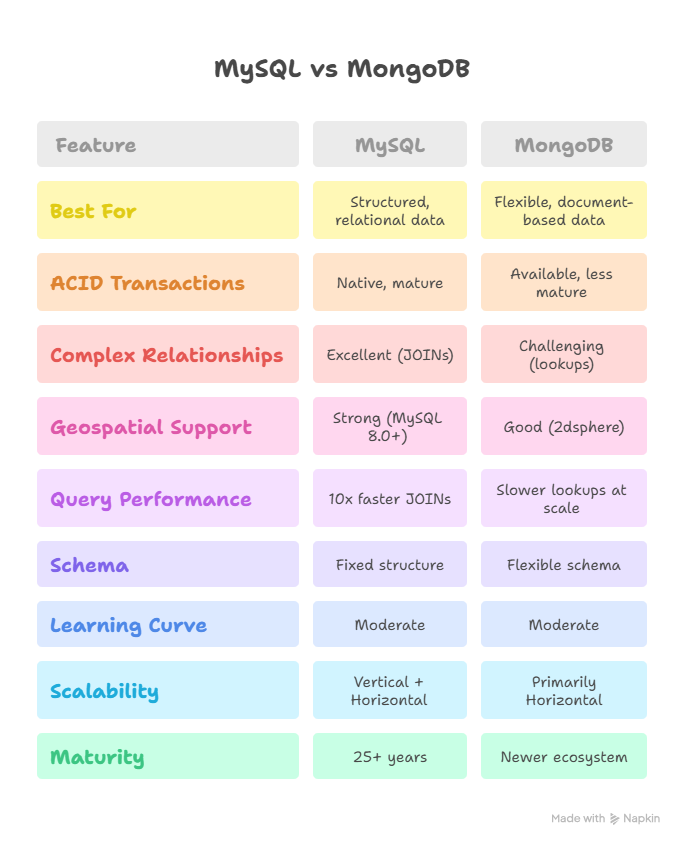
MySQL vs MongoDB: Quick Comparison Table
When Should You Choose MongoDB?
MongoDB is a great choice when:
- Your schema changes frequently
- You have truly unstructured data
- You need rapid prototyping
- Your data is naturally document-based (blogs, catalogs)
- Horizontal scaling is priority #1
Our Final Decision: MySQL Won
For our SaaS platform, MySQL was the clear winner:
- Deep Relationships – Relational model fits our hierarchy perfectly
- ACID Transactions – Billing integrity is non-negotiable
- Geospatial Queries – Native spatial functions with relational data
- Proven Scalability – Handles growth without added complexity
- Mature Ecosystem – 25+ years of reliability and support
Key Takeaways for Your SaaS
Choose MySQL if you have:
- Complex entity relationships
- Financial transactions
- Need for data consistency
- Structured, predictable data
- Location-based features
Choose MongoDB if you have:
- Rapidly changing data structures
- Document-centric content
- Primarily read-heavy workloads
- Need extreme horizontal scaling
- Unstructured data formats
Conclusion
The MySQL vs MongoDB debate isn’t about which is “better.”
It’s about which fits your specific needs.
For our SaaS platform with deep relationships, critical billing operations, and geospatial requirements, MySQL’s relational strengths, ACID guarantees, and mature ecosystem made it the obvious choice.
As we scale, we’re confident MySQL will continue to deliver the performance, reliability, and data integrity our platform demands.
What database are you using for your SaaS? Share your experience in the comments below.
Need help choosing a database for your project? Consider your data structure, transaction requirements, and scalability needs before deciding.
Comments