- AI search visibility starts with crawl access. This guide explains how GPTBot, OAI-SearchBot, ClaudeBot, Google-Extended and PerplexityBot interact with robots.txt, server logs, CDNs and WAFs—and how to verify that the crawlers you want can actually reach your website.
- Key takeaways
- AI crawlers serve different purposes: training, search/indexing, and user-triggered retrieval.
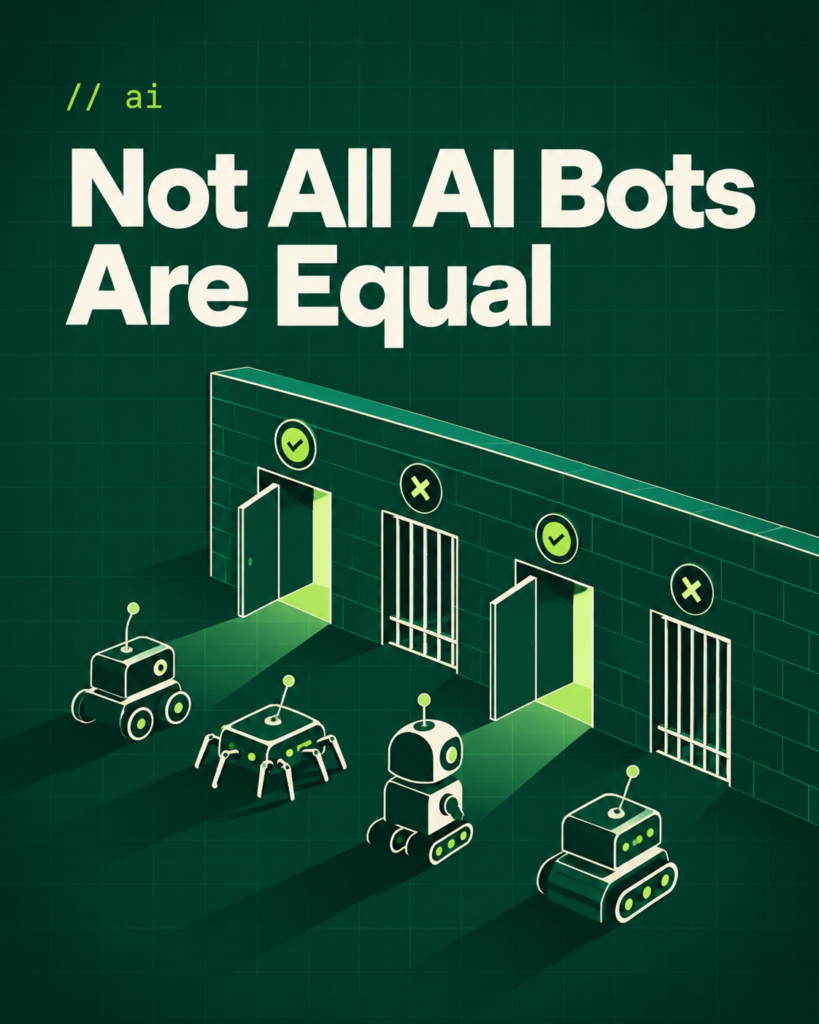
- OAI-SearchBot and GPTBot should be treated separately because search discovery and model training are different controls.
- Anthropic provides separate controls for ClaudeBot, Claude-SearchBot, and Claude-User.
- Google-Extended is a robots.txt control token, not a standalone crawler like Googlebot.
- Allowing a crawler in robots.txt does not guarantee access—CDNs, WAFs, bot protection and rate limits can still block it.
- Server logs are essential for confirming crawler requests, URLs visited, status codes and crawl frequency.
- A 403 usually indicates access or security blocking, while repeated 429 responses can indicate rate limiting.
- User-Agent strings alone are not sufficient for bot verification; use official IP information where available.
- A proper AI crawl audit should test the full path: robots.txt → CDN/WAF → web server → application → content.
- AI crawler access should be configured deliberately based on whether you want to allow search visibility, training access, or both.
There are two technical details worth making central to the article:
OpenAI separates search from training. OAI-SearchBot is used for ChatGPT Search discovery, while GPTBot is associated with content that may be used to improve/train foundation models. A site can therefore allow search discovery while blocking potential training. OpenAI Developers
User-agent: OAI-SearchBot
Allow: /

User-agent: GPTBot
Disallow: /
Anthropic now has three separate controls, so writing only about ClaudeBot would be incomplete:
ClaudeBot         → model development/training
Claude-SearchBot  → search indexing
Claude-User       → user-triggered retrieval
Anthropic states that all three respect its documented controls, although they serve different purposes. Claude Help Center
There is also an important Google nuance: Google-Extended is not a separate HTTP crawler user agent. It is a robots.txt control token. Crawling itself is performed using existing Google crawler user agents. Blocking Google-Extended does not remove a site from normal Google Search. Google for Developers
For Perplexity, PerplexityBot builds/searches its index and is not used to train foundation models, while Perplexity-User handles user-triggered retrieval. Perplexity says Perplexity-User generally ignores robots.txt because the request is user initiated. Perplexity
Article structure
H1 — AI Crawler Access in 2026: A Technical Guide to GPTBot, ClaudeBot, Google-Extended & PerplexityBot
1. AI Crawlers Are Not All the Same
- training crawlers
- search/index crawlers
- user-triggered fetchers
- why treating them all as
User-agent: *can be a mistake
2. OpenAI Crawlers
OAI-SearchBotGPTBotChatGPT-User- published IP ranges
- search vs training
- recommended robots configuration
OpenAI publishes IP ranges for its automated crawlers and specifically recommends checking CDN/firewall access in addition to robots.txt. OpenAI Developers
3. Anthropic Crawlers
ClaudeBotClaude-SearchBotClaude-UserCrawl-delay- robots configuration
4. Google-Extended
- why it isn’t Googlebot
- why it isn’t a normal crawler UA
- Gemini/model controls
- relationship with Google Search
- what blocking it actually changes
5. Perplexity
PerplexityBotPerplexity-User- official IP JSON
- WAF configuration
- search indexing vs live retrieval
6. Build a Correct robots.txt for AI Crawlers
Example scenario:
Allow AI search visibility but block model-training crawlers.
# OpenAI Search
User-agent: OAI-SearchBot
Allow: /

# OpenAI model training
User-agent: GPTBot
Disallow: /

# Claude Search
User-agent: Claude-SearchBot
Allow: /

# Claude user-triggered retrieval
User-agent: Claude-User
Allow: /

# Claude model development
User-agent: ClaudeBot
Disallow: /

# Google Gemini controls
User-agent: Google-Extended
Disallow: /

# Perplexity Search
User-agent: PerplexityBot
Allow: /
We should clearly label this as an example policy, not a universal recommendation.
7. robots.txt Is Only Layer One
This is where the article becomes much more technical:
AI crawler
    ↓
DNS
    ↓
CDN
    ↓
WAF / Bot Protection
    ↓
Rate Limiter
    ↓
Web Server
    ↓
Application
    ↓
Content
A crawler can be:
robots.txt → ALLOWED
Cloudflare → BLOCKED
Result     → crawler still cannot access page
OpenAI specifically warns about WAFs, bot protection, JavaScript challenges, CAPTCHAs and 403/429 responses causing crawler failures. OpenAI Help Center Perplexity similarly recommends validating both user-agent and official IP ranges when configuring WAF rules. Perplexity
8. Detect AI Crawlers in Server Logs
Nginx:
grep -Ei \
'OAI-SearchBot|GPTBot|ClaudeBot|Claude-SearchBot|PerplexityBot' \
/var/log/nginx/access.log
Apache:
grep -Ei \
'OAI-SearchBot|GPTBot|ClaudeBot|Claude-SearchBot|PerplexityBot' \
/var/log/apache2/access.log
Then analyse:
crawler
URL
status
timestamp
IP
response size
response time
Especially investigate:
200 → accessible
301/302 → redirect
403 → WAF/security block
404 → crawler reached nonexistent URL
429 → rate limited
5xx → server-side failure
9. Never Trust User-Agent Alone
A fake bot can send:
User-Agent: GPTBotSo the technical section should show why production allowlisting should use the provider’s published infrastructure/IP information where available rather than blindly trusting a header. OpenAI and Perplexity currently publish crawler IP sources. OpenAI Developers
10. Cloudflare/WAF Problems
- Bot Fight Mode
- managed challenges
- JavaScript challenges
- rate limiting
- IP reputation
- geo restrictions
- custom firewall rules
403429
11. Test Whether an AI Crawler Can Actually Reach Your Site
Include:
curl -I https://example.com/robots.txtand:
curl -A "OAI-SearchBot" https://example.com/with an important warning that changing the User-Agent with curl tests your own server rules; it does not prove you’re a genuine OpenAI crawler.
12. Recommended Architecture
robots.txt
     │
     ├── Training bots → allow/block by policy
     │
     ├── Search bots → allow
     │
     └── User fetchers → decide separately
                         ↓
                    CDN / WAF
                         ↓
                   IP validation
                         ↓
                     Web server
                         ↓
                  Access logging
13. Technical Audit Checklist
Finish with perhaps 15 practical checks, including:
- robots.txt returns
200 - correct bot groups
OAI-SearchBotaccessible- training policy intentionally configured
- Claude search/training rules separated
- Google-Extended understood correctly
- CDN doesn’t challenge allowed crawlers
- WAF doesn’t return
403 - rate limiter doesn’t return excessive
429 - crawler IP verification
- server logs retained
- redirects tested
- HTML returned without login
- sitemap reachable
- important assets/content not accidentally blocked
1. What is the difference between GPTBot and OAI-SearchBot?
GPTBot is associated with OpenAI's model-training and improvement processes, while OAI-SearchBot is used for discovering and surfacing webpages in ChatGPT Search. You can configure separate robots.txt rules for each crawler.
2. Can I allow AI search crawlers but block AI training crawlers?
Yes. For example, you can allow OAI-SearchBot for ChatGPT Search while blocking GPTBot. Similar separation is possible for Anthropic crawlers such as Claude-SearchBot and ClaudeBot.
3. Does allowing a bot in robots.txt guarantee that it can crawl my website?
No. A crawler may be permitted by robots.txt but still be blocked by Cloudflare, a WAF, rate limiting, IP restrictions, JavaScript challenges, authentication, or server-level security rules. Server logs should be checked to confirm actual access.
4. Is Google-Extended an AI crawler?
Not exactly. Google-Extended is a robots.txt control token used to manage how Google may use site content for certain Gemini and generative AI systems. It is not a standalone crawler user agent in the same way as GPTBot or ClaudeBot.
5. How can I verify that an AI crawler is actually visiting my website?
Check your Nginx, Apache, CDN, or Cloudflare access logs for crawler user agents such as OAI-SearchBot, GPTBot, Claude-SearchBot, and PerplexityBot. Review the requested URL, IP address, HTTP status code, timestamp, and response behavior. For stronger verification, compare the request IP with official IP ranges published by the crawler provider.