
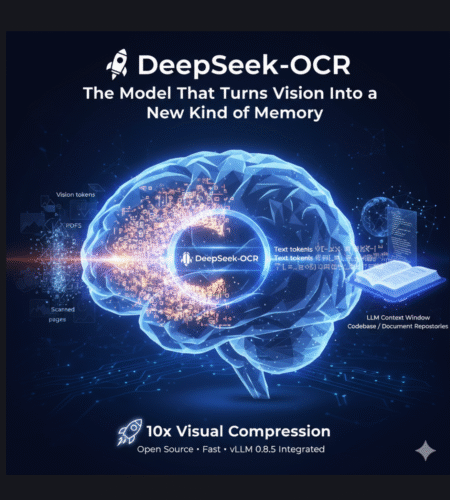
By redefining what “OCR” means, DeepSeek may have quietly opened a new chapter in how large models think, compress, and remember.
TL;DR for Developers
- DeepSeek-OCR isn’t just a text-recognition model — it’s a visual compression system that might expand LLM context windows by 10× or more.
- Instead of vision tokens being less efficient than text tokens, DeepSeek flips the script — compressing visual information 10× better than words.
- This could enable LLMs to process entire codebases, document repositories, or company wikis in a single context window.
- It’s open source, blazing fast (≈ 2 500 tokens/s on A100), and already integrated with vLLM 0.8.5.
1. What DeepSeek-OCR Actually Is
At first glance, DeepSeek-OCR looks like another powerful Optical Character Recognition tool. It accurately extracts text from images, PDFs, scanned pages — all that.
But under the hood, it’s really a research experiment in optical context compression:
“A way to represent language and knowledge visually — using fewer, denser tokens.”
Traditional OCR just converts images → text.
DeepSeek-OCR goes deeper: it encodes the visual layout itself as compact tokens, allowing large models to reason over images as if they were text, but with far smaller memory requirements.
That’s why researchers like Jeffrey Emanuel (@doodlestein) called it “a shocking paper hidden under a boring title.”
2. The Core Innovation — Visual Token Compression
The Problem (Old Way)
In multimodal LLMs like Gemini, GPT-4o, or Claude, image inputs are broken into “visual tokens.”
But these are inefficient — one page of text can explode into tens of thousands of visual tokens.
- 10 000 words → 30 000 – 60 000 visual tokens
- Huge GPU cost, limited context, slower inference
The Breakthrough (DeepSeek’s Way)
DeepSeek realized vision tokens can actually be denser than text tokens — if you encode them correctly.
Their architecture uses:
- DeepEncoder — a visual encoder that compresses image features 16× using convolutional layers
- Mixture-of-Experts (MoE) Decoder — that learns to reconstruct text with minimal loss
The result:
“10 000 words of text can be stored in just 1 500 visual tokens — a 10× compression ratio.”
This is not just a storage trick — it fundamentally changes how models might handle information.
As Emanuel put it:
“You could theoretically cram all of a company’s key internal documents into a single context and just query on top.”
3. Why It Matters (and How It Could Change LLMs)
Imagine you could feed your entire codebase, documentation, and notes into an LLM’s context window at once — no retrieval pipeline, no database, no chunking.
That’s the long-term implication here.
Reasoning Over Compressed Visual Memory
DeepSeek suggests that a model can reason just as effectively over compressed visual tokens as it can over normal text tokens — or at least close enough that the trade-off is worth it.
If true, this could:
- Expand context windows → 10 – 20 million tokens
- Reduce inference cost → less GPU VRAM per context
- Simplify RAG pipelines → less need for retrieval systems
- Enable persistent “memory caches” → load large knowledge bases directly into prompts
As Karpathy put it:
“Maybe it makes more sense that all inputs to LLMs should be images. Even text could be rendered and fed in visually — delete the tokenizer!”
He argues that tokenizers are brittle, lossy, and full of Unicode quirks — whereas pixels are pure, consistent, and more expressive.
4. Getting Started — Developers’ Quick Guide
If you just want to use DeepSeek-OCR as a high-accuracy OCR engine, you can deploy it locally or via API.
Here’s how:
Install
pip install torch transformers pillow
Run Example
from transformers import AutoModel, AutoProcessor
from PIL import Image

model_name = "deepseek-ai/DeepSeek-OCR"
processor = AutoProcessor.from_pretrained(model_name)
model = AutoModel.from_pretrained(model_name)

image = Image.open("page.png")
inputs = processor(images=image, return_tensors="pt")
outputs = model.generate(**inputs)
print(processor.batch_decode(outputs, skip_special_tokens=True)[0])
You’ll get OCR text directly.
For speed, try vLLM 0.8.5 — it delivers ≈ 2 500 tokens/s on A100 GPUs.
5. Developer Implications — Beyond OCR
| Use Case | Why DeepSeek-OCR Matters |
|---|---|
| Document Digitization | Extracts structured text from complex PDFs |
| Context Caching | Fit entire projects in memory for LLMs |
| Code Assistants | Embed whole codebases visually for reasoning |
| Knowledge Bases | Replace retrieval systems with compressed visual memory |
| Vision LLMs Research | Study multimodal reasoning & hybrid compression |
Think of it as JPEG for text — a lossy but intelligent compression that keeps semantic meaning even when data is shrunk.
6. Community Reactions — In Simple Words
The Reddit and X discussions reveal a rare consensus among developers and researchers:
- ComputeVoid (r/LocalLLaMA): “This frames the bottleneck as a feature, not a flaw. Image tokens are more expressive than text tokens.”
- LeatherRub7248: “It’s like human memory — detail fades, but meaning remains. You still ‘see’ the big picture.”
- Andrej Karpathy: “Tokenizers are ugly. Let’s feed LLMs images instead. OCR is just the beginning.”
- vLLM Project: “DeepSeek-OCR compresses visual contexts 20× while keeping 97 % accuracy.”
In short: it’s not only about reading images — it’s about reimagining how AI stores thought.
7. The Future — From OCR to Optical Reasoning
DeepSeek-OCR might be remembered as the moment vision models stopped being “add-ons” and became the core of multimodal reasoning.
We could soon see:
- Hybrid LLMs that take only images as input (text rendered visually)
- Gigantic in-context memories → models that remember everything
- RAG replacement architectures → direct knowledge caching
- Compression-aware reasoning → adaptive precision depending on context importance
As one Redditor said:
“This is like going from 2D to 3D graphics for AI memory.”
8. What You Can Do Now
- Experiment — Run DeepSeek-OCR locally or via API, try encoding your own documents.
- Think Differently — Don’t treat it as “OCR.” It’s a new kind of information compressor.
- Collaborate — Explore hybrid uses: OCR + LLM reasoning, visual embeddings for context expansion, or code-to-image caching.
- Follow Research — Related papers:
- DeepSeek-OCR: Context Optical Compression
- DeepSeek Sparse Attention (Oct 2025)
- Glyph ( z.ai ) – similar concurrent work using rendered text for 1 M-token contexts
Final Thoughts
DeepSeek-OCR started as a model for reading text.
But what it really gives us is a new way to think about memory and context in AI.
For freshers, it’s an invitation to explore multimodal systems.
For seasoned developers, it’s a glimpse of where model architecture is headed:
toward optical cognition — where knowledge is stored, reasoned, and recalled visually.
“You could basically cram all your company’s knowledge into a prompt.” — Jeffrey Emanuel
The tokenizer era might just be ending.
Welcome to the age of optical language models.
References & Resources
- Official Paper: DeepSeek-OCR: Context Optical Compression (PDF)
- Source Code: DeepSeek-OCR GitHub Repository
Comments